


– By the end of this chapter, you will be able to:
—) Explain organization behavior.

—) Describe basic units of analysis in organization behavior.
—) Discuss contributing disciplines to organization behavior.
—) Explain management and organization behavior in the 21st century.

– A group of two or more people working together to achieve some
common objectives.

the purpose of achieving predetermined outcomes through the use of financial, human, and material resources.
– A collection of people working together under a defined structure for

– Behavior is the way in which an animal or person responds to a situation.
– Behavior refers to:

—) What their attitudes are
—) How they perform
—) What people do in the organization

– Is the study of behavior in organizations.

the purpose of applying such knowledge towards improving an organizational effectiveness.
– A field of study that investigates the impact that individuals, groups and organizational structure have on behavior within the organization, for

– Key Points:

—) First, organizational behavior is an investigative study of individuals and groups.
—) Second, the impact of organizational structure on human behavior.
—) Third, the application of knowledge to achieve organizational effectiveness.

– The study of organizational behavior embraces an understanding of:
—) The behavior of people.

—) The process of management.
—) The organizational context in which the process of management takes place.
—) Organizational processes and the execution of work.
—) Interactions with the external environment of which the organization is part.

– Generally, organizational behavior provides a set of tools that allow:

—) People to understand, analyze, and describe behavior in organizations.
—) Managers to improve, enhance, or change work behaviors so that individuals, groups, and the whole organization can achieve their goals.
– Group Behavior
– Organization Structure and Job Design


—) In order to understand organizations, it is necessary to understand people, particularly from the perspective of individual organizational member.
—) Much of what we know about individuals is drawn from the discipline of psychology.
—) Within this perspective, theories of motivation and satisfaction are explored to assist in understanding the behavior and performance of individual organizational members.


– Group Behavior

– A second level of analysis focus upon the interactions of people as they work in committees, teams, groups, units, or departments.
—) How do people work together in groups?
—) What factors determine whether a group will be cohesive and productive, as opposed to fragmented and unproductive?
—) How does leadership influence group members and their ability to
work together co-operatively and productively?
– This level of analysis draws in particular on theories from social psychology.

– The third level of analysis has to do with the way.

—) In which jobs are designed
—) Organizations are formally structured and

—) Concern at this level of analysis is with the relationship between two organization and its environment.
—) Emphasis is placed upon understanding how organization structure and job design influence effectiveness.
—) An understanding of organizational design must characterize and influence organizational behavior.


– Organizations are composed of individuals and groups.
– Organizations are oriented toward the achievement of goals.

to accomplish their goals.
– Organizations need employees’ specialization and coordination in order

– Organization Behavior is an applied behavioral science that is built upon contributions from a number of behavioral disciplines.

—) Sociology
—) Political Science
—) Social Psychology
—) Anthropology
—) Psychology

—) Psychologists have been able to modify individual behavior largely with the help of various studies.
—) Is an applied science, which attempts to explain human behavior in a particular situation and predicts actions of individuals.

– It has contributed towards various theories on:
Learning | Leadership | Job Design |
Motivation | Job Satisfaction | Work Stress |
Personality | Performance Appraisal | Conflict Management |
Training and Development | Attitude | |
Theories on Individual Decision Making | Ego State |
– Studies of these theories can improve personal skills, bring change in attitude and develop positive approach to organizational systems.

– Sociology:
– Science of Sociology studies the impact of culture on group behavior.

– Has contributed to a large extent to the field of:
—) Group-dynamics
—) Roles that individual plays in the organization and communication
—) Norms, status, power, and conflict management
—) Formal organization theory, group processes
—) Group decision-making

– Political Science:

—) The branch of knowledge concerned with political activity and behavior.
—) Stability of government at national level is one major factor for promotion of international business, financial investments, expansion and employment.
—) Various government rules and regulations play a very decisive role in growth of the organization.
—) All organizations have to abide by the rules of the government of the
day.
—) The branch of psychology concerned with social interactions.

psychology and sociology.
—) It focuses on the influence of people on one another.
—) Is an area within psychology, blending concepts from both

—) Working organizations are formal assembly of people who are assigned specific jobs and play a vital role in formulating human behavior.
—) It is a subject where concept of psychology and sociology are blend to achieve better human behavior in organization.
—) The field has contributed to manage change, group decision-making, communication and ability of people in the organization, to maintain social norms.

—) It is a field of study relating to human activities in various cultural and environmental frameworks.
—) It understands difference in behavior based on value system of different cultures of various countries.
—) The study is more relevant to organizational behavior today due to globalization, mergers and acquisitions of various industries.

—) The advent of the 21st century has created a situation wherein cross-cultural people will have to work in one particular industry.
—) Managers will have to deal with individuals and groups belonging to different ethnic cultures and exercise adequate control or even channelize behavior in the desired direction by appropriately manipulating various cultural factors.

– Today’s workplace is indeed undergoing immense and permanent changes.

– The 21st century environment requires new-taking and new ways of
managing.
– The nature of work is changing so rapidly that rigid job structures
impede the work to be done now, and that may drastically change the following year, month, or even week.
—) Knowledge is replacing infrastructure.

—) Values and self-leadership are replacing direct supervision i.e. command and control supervisions.
—) Networks are replacing hierarchies.
—) Virtual teams are replacing committees.
—) Companies are looking for employees with emotional intelligence, not just technical smarts.
—) Globalization has become the mantra of corporate survival.

—) Co-workers are not down the hall; they are at the other end of internet connections. Chances are they live somewhere else on the planet.
—) Organizations have been ―re-engineered‖ for greater speed, efficiency and flexibility.
—) Teams are pushing aside the individual as the primary building block of organizations.
—) Command and control management is giving ways to participative
management and empowerment.

—) Employees increasingly are being viewed as internal customers.
—) Managerial shifting.
—) Ego centered leaders are being replaced by customer centered leaders.
organizations are being encountered challenges:

—) Improving people skills
—) Managing work force diversity
—) Responding to globalization
—) Empowering people
—) Improving quality and productivity
organizations are being encountered challenges:

—) Stimulating innovation and change
—) Coping with ―Temporariness‖ – today, change is an ongoing activity for most managers. So, workers need to continually update their knowledge and skills to perform new job requirements.
—) Declining employee loyalty
—) Improving ethical behavior

– Individuals in Organizations
—) Individual Differences: Personality and Ability

—) Work Values, Attitudes, Moods, and Emotions
—) Perception, Attribution, and the Management of Diversity
—) Learning and Creativity
—) The Nature of Work Motivation
—) Creating a Motivating Work Setting
—) Pay, Careers, and Changing Employment Relationships
—) Managing Stress and Work–Life Balance

– Groups and Team Processes
—) The Nature of Work Groups and Teams

—) Effective Work Groups and Teams
—) Leaders and Leadership
—) Power, Politics, Conflict, and Negotiation
—) Communication in Organizations
—) Decision Making and Organizational Learning

– Organizational Processes
—) Organizational Design and Structure

—) Organizational Change and Development
—) Organizational Culture and Ethical Behavior

– Organizational behavior provides a set of tools that allow: people to

understand, analyze, and describe behavior in organizations; and managers to improve, enhance, or change work behaviors so that individuals, groups, and the whole organization can achieve their goals.
– Organizational behavior is an applied behavioral science that is built
upon contributions from a number of behavioral disciplines. Psychology, Sociology, Political science, Social psychology and Anthropology.


– By the end of this chapter, you will be able to:
—) Explain perception and individual decision making.

—) Discuss individual’s personality.
—) Explain the rationale behind motivation.
—) discuss the concept of stress.
—) Describe components of attitude.



– Perception is the process by which individuals organize and interpret their sensory impressions in order to give meaning to their environment.
– Perception is like beauty that lies in the eyes of beholder.

– Individual differs in the way they sees, interprets and understands a particular event.

– The study of perception is very important in the organization because it

in correct way.

– Perception: A process by which individuals organize and interpret their
sensory impressions in order to give meaning to their environment.

– People’s behavior is based on their perception of what reality is, not on reality itself.
– The world as it is perceived is the world that is behaviorally important.
etonline.edu.et


– Perception is influenced by the perceiver attitude, motive, interest, experience, and expectation.

—) Attitude is a settled way of thinking or feeling.
It can be positive or negative.
—) Motive is a factor inducing a person to act in a particular way.
Motive is nothing but unsatisfied needs.
—) Interest is the state of wanting to know about something or someone.
Interest is persons liking for a particular thing in an individual.

– A target’s characteristics can affect what is perceived.

—) Novelty is a new or unfamiliar thing or experience.
—) Physical and time proximity.
– Perception is influenced by the target novelty, motion, sounds, size, Background, proximity.

– Perception is influenced by the situation time, work setting, and social setting.
—) Change in situation leads to incorrect perception about a person.


– It has been seen that our perception about the people is greatly influenced by the assumption we make about a person and not by

– There are two factors, which has an impact on human behavior.
—) First is internally caused behavior factors on which individual has a full control
—) Secondly the externally caused behavior refers to the behavior which has been caused due to external factors and that the individual has no control over it.


– Attribution theory suggest that when we evaluate human behavior, it is either internally caused or it is caused due to external factors.


—) Refers to whether an individual acts the same way in other situations.
—) What we want to know is whether this behavior is unusual.
If it is, the observer is likely to give the behavior an external attribution.
If this action is not unusual, it will probably be judged as internally caused.


—) If everyone who is faced with a similar situation responds in the same way, we can say the behavior shows consensus.
—) From an attribution perspective, if consensus is high, you would be expected to give an external attribution to the employee’s tardiness.
—) But if other employees who took the same route made it to work on time, you would conclude the cause was internal.

– Distinctiveness: Shows different behaviors in different situations.
– Consensus: Response is the same as others to same situations.
– Consistency: Responds in the same way over time.


– Fundamental Attribution Error
– The tendency to:

—) Underestimate the influence of external factors
—) Overestimate the influence of internal factors
– When making judgments about the behavior of others.
– In general, we tend to blame the person first, not the situation.
– Halo Effect
– Contrast Effects

– Projection
– Stereotyping
—) People selectively interpret what they see on the basis of their interests, background, experience and attitudes.

– Halo Effect
—) Drawing a general impression about an individual on the basis of single characteristic.
a

– Contrast Effects

—) Evaluation of a person’s characteristics that are affected by comparisons with other people recently encountered who rank higher or lower on the same characteristics.
– Projection
—) Attributing one’s own characteristics to other people.
– Stereotyping
—) Judging someone on the basis of one’s perception of the group to which that person belongs.

or events.
– Attitudes are thus responses to situations.

– Attitude is a tendency or predisposition to evaluate an object or symbol of that object in a certain way.
– Components of attitude:
—) Cognitive component
—) Affective component
—) Behavioral component

– Cognitive Component
—) The opinion or belief segment of an attitude.

individual may possess or has faith in.
—) It consists of belief, ideas, values and other information that an

– Affective Component
—) The emotional or feeling segment of an attitude.

—) Is related to person’s feelings about another person, which may be positive, negative or neutral.
—) It is an expression of feelings about a person, object or a situation.

– Behavioral Component

—) An intention to behave in a certain way toward someone or something.
—) Is related to impact of various situations or objects that lead to individual’s behavior based on cognitive and affective components.
—) Cognitive and affective components are bases for such behavior.
—) Former two components cannot be seen; only the behavior component can be seen.
—) Former is important because it is a base for formation of attitude.

– A person can have thousands of attitudes, but organizational behavior focuses our attention on a job-related attitudes.

—) Job Involvement
—) Organizational Commitment
—) Job Satisfaction

– Job Satisfaction

—) A collection of positive and/or negative feelings that an individual holds toward his or her job.
—) An individual’s general attitude toward his or her job.
—) A person having a high level of satisfaction will generally hold a positive attitude while dissatisfied people will generally display negative attitude towards life.

– Job Involvement

—) Identifying with the job, actively participating in it, and considering performance important to self-worth.
—) Employees with a high level of job involvement strongly identify with and really care about the kind of work they do.
—) High levels of job involvement have been found to be related to

– Organizational Commitment

—) Identifying with a particular organization and its goals, and wishing to maintain membership in the organization.
—) Affective, Normative, and Continuance Commitment
– High Organizational Commitment
—) Increase productivity and job satisfaction
—) Minimize absenteeism and turnover
—) Make better work place relation

—) Personality
– Are certain personality types better adapted for certain job types?

– Why are some people quiet and passive, while others are loud and aggressive?

– It is the manner in which a person acts and interacts.

– It is the sum total of ways in which an individual reacts and interacts with others.
– It is measurable traits a person exhibits.
– It is the stable patterns of behavior and consistent internal states that determine how an individual reacts to and interacts with others.

– Personality is an organized whole; otherwise
—) The individual would have no meaning.

– Personality appears to be organized into patterns that are to some degree observable and measurable.
– Although personality has a biological basis, its specific development is
also a product of social and cultural environments.

– Personality involves both common and unique characteristics.

– Every person is different from every other person in some respects while being similar to other persons in other respects.

– These five ideas are included in this definition of personality:

—) An individual’s personality is a relatively stable set of characteristics, tendencies, and temperaments that have been significantly formed by inheritance and by social, cultural, and environmental factors.
—) This set of variables determines the commonalities and differences in the behavior of the individual.

– People’s personalities can be described in a variety of ways:

—) Relaxed and easygoing.
—) Fun to be around, or shy and quiet.
—) Hard to get to know and may sometimes seem dull.
—) Perfectionists; they can be critical, impatient, demanding, and intense.

– Personality is now generally considered to be made up of both

—) Hereditary
—) Environment
—) Situation
conditions.

– Heredity: Refers to those factors that were determined at conception.

—) Physical stature, facial attractiveness, gender, temperament, muscle composition and reflexes, energy level, and biological rhythms are characteristics that are generally considered to be either completely or substantially influenced by who your parents were: that is, by their biological, physiological, and inherent psychological
makeup.
– The heredity approach argues that the ultimate explanation of an
individual’s personality is the molecular structure of the genes, located in the chromosomes.

– Environment:

—) Among the factors that exert pressures on our personality formation are the culture in which we are raised; our early conditioning; the norms among our family, friends, and social groups; and other influences that we experience.
—) The environment we are exposed to plays a substantial role in shaping our personalities.

– Situation:
—) Influences the effects of heredity and environment on personality.

—) An individual’s personality, although generally stable and consistent, may be more effective in some situations than others.
—) More specifically, the different demands of different situations call forth different aspects of our personalities.


Hleredity
Enviro,nme11t
Si'tuation

– Extroversion/Introversion (E or I): This dimension refers to how people focus themselves:

—) Inside (introversion) or
—) Outside (extroversion)
– Sensing/Intuiting (S or N): This dimension refers to how people gather information:
—) Very systematically (sensing) or
—) Relying on intuition (intuiting)

– Thinking/Feeling (T or F): This dimension refers to how a person prefers to make decisions:

—) Objectively and impersonally (thinking) or
—) Subjectively and interpersonally (feeling)
– Judging/Perceiving (P or J): This dimension refers to how people order their daily life:
—) Being decisive and planned (judging) or
—) Spontaneous and flexible (perceiving)

– Extroversion
—) This dimension captures one’s comfort level with relationships.

—) A personality factor that describes the degree to which someone is sociable, talkative, and assertive.
—) Extroverts (high in extroversion) tend to be outgoing, assertive, and sociable.
—) Introverts tend to be reserved, shy, and quiet.

– Agreeableness:

—) A personality factor that describes the degree to which someone is good-natured, cooperative, and trusting.
—) This dimension refers to an individual’s tendency to defer to others.
—) Highly agreeable people are cooperative, warm, and trusting.
—) People who score low on agreeableness are cold, disagreeable, and antagonistic.

– Conscientiousness:

—) A personality factor that describes the degree to which someone is responsible, dependable, persistent, and achievement-oriented.
—) This dimension is a measure of reliability.
—) A highly conscientious person is responsible, organized, dependable, and persistent.
—) Those who score low on this dimension are easily distracted, disorganized, and unreliable.

– Emotional Stability:

—) A personality factor that describes the degree to which someone is calm, self-confident, and secure.
—) This dimension taps a person’s ability to withstand stress.
—) People with positive emotional stability tend to be characterized as calm, self-confident, and secure.
—) Those with high negative scores tend to be nervous, anxious, depressed, and insecure.

– Openness to Experience:

—) The final dimension addresses one’s range of interests and fascination with novelty.
—) It is a personality factor that describes the degree to which someone is imaginative, artistically sensitive, and intellectual.
—) Extremely open people are creative, curious, and artistic.
—) Those on Low on openness to experience are more conventional and find comfort in the familiar.

—) A personality with aggressive involvement in a chronic, incessant struggle to achieve more and more in less and less time and, if necessary, against the opposing efforts of other things or other people.

—) Type As are often impatient, hurried, competitive, and hostile, but these traits tend to emerge most often when a Type A individual experiences stress or challenge.
—) Type As are fast workers because they emphasize quantity over quality.
—) In managerial positions, Type As demonstrate their competitiveness by working long hours and, not infrequently, making poor decisions because they make them too fast.
—) Stressed Type As are also rarely creative.

Because of their concern with quantity and speed, they rely on past experiences when faced with problems.
They will not allocate the time that is necessary to develop unique
solutions to new problems.
– They seldom vary in their responses to specific challenges in their environment, and so their behavior is easier to predict than that of
Type Bs.

– Type B Personality:

—) Never suffer from a sense of time urgency with its accompanying impatience.
—) Feel no need to display or discuss either their achievements or accomplishments unless such exposure is demanded by the situation.
—) Play for fun and relaxation, rather than to exhibit their superiority at any cost.
—) Can relax without guilt.


– The willingness to exert high levels of effort toward organizational goals, conditioned by the effort’s ability to satisfy some individual need.

stimulating action.
– Encouraging and initiating the others.
– Motivation is the energizing of human behavior or the process of

– Motivation is defined as ―inner burning passion caused by need, wants

and desire which propels an individual to exert his physical and mental energy to achieve desired objectives‖.
—) Efficiency of a person depends upon performance.
—) Performance can be expressed as under.
– Motivation is ―a process of stimulating people to action or accomplish desired goals‖.

– Mc Farland has defined ―motivation as the way in which urges, drives,

desires, aspirations, strivings needs direct, control or explain the behavior of human beings‖.

– Motivation is a psychological phenomenon.

– Motivation is a continuous process - since need is a continuous phenomenon.
– Motivation is caused due to anticipated perceived value from an action.
—) Perceived value is the probability or the expectancy.
– The more the motivation level, the higher will be efforts to get over the tension and in the process job accomplishment would take place.

– Individual is motivated by positive motivation. It refers to incentives offered by the organization to achieve efficiency.

—) Incentive can be monetary such as increase in pay, allowances, and payment of bonus-payment for additional or overtime work. Monetary rewards prevent individuals from getting demotivated.
—) Incentive can also be non-monetary like issuing of certificates for excellence, awards, recognition, status, job enrichment, competitions and so on. Non-monetary awards motivates individual as it is related to the inner/psychological aspects.

– High level of performance.
– Low employee turnover and absenteeism.
– Acceptance of organization change.

– Organizational Image:
—) Employees are the mirrors of any organization. It will have a positive impact on the employees and the image of the organization will be improved.

– Motivation can be classified on several bases.
– On the basis of approach, motivation can be classified as:

—) Negative
—) Positive

– Positive Motivation

—) Implies creation of an environment in which people can satisfy their needs and aspirations.
—) Under it rewards and incentives are offered to inspire employees. All necessary facilities are provided to workers. They are offered prizes and awards for best performance.
—) Positive motivation removes the psychological barrier and develops a sense of affiliation.

– Negative Motivation
—) Involves creating a sense of fear or unhelpful environment.

—) Workers who do not perform well are penalized.
—) There is a cut in their facilities and remuneration.
—) Demotion, layoffs are other punitive measures
—) Negative motivation creates detachment between the individuals and the organization and lack of integrity to the purpose.
—) Negative motivation is based on pessimistic view which holds that
only fear of punishment will force employees to improve their performance.

– On the basis of the type of incentives used, motivation may be:
—) Financial
—) Non-financial


– Financial Motivation
—) Implies use of monetary benefits to inspire employees.

benefits and so on.
—) Include wages and salaries, bonus, fringe benefits, retirement

– Non-financial Motivation
– Are not associated with monetary rewards. These include:

—) Recognition of work done
—) Greater involvement in decision-making
—) Responsibility, challenging job, and so on
—) Praise, competition
—) Knowledge of results, suggestion system, and opportunity for growth are other important non-financial motivators.

– On the basis of the nature of reward used, motivation may be:
—) Extrinsic
—) Intrinsic


– Extrinsic Motivation
—) Extrinsic motivators do not occur on the job but around the job.

—) These factors include pay allowances, bonus, and fringe benefits.
—) Extrinsic reward may be direct which are linked with performance and indirect compensation like free housing, conveyance, medical facilities and so on.
—) Generally direct compensation is more effective motivator.

– Intrinsic Motivation

—) Intrinsic motivation occurs on the job and provides satisfaction while the job is being performed.
—) Intrinsic or internal motivators include status, authority, participation, challenging task and so on - variety of work, freedom for discretion, greater responsibility opportunity for advancement are also intrinsic rewards.

– Maslow’s Theory of Need Hierarchy
– Motivation and Hygiene Two Factor Theory
– Theory X and Theory Y

– ERG Theory
– Vroom’s Theory of Motivation (Performance Satisfaction)
– Porter - Lawler Theory
– It is based on the following assumptions:

—) There are five levels of human needs - hierarchical in nature.
—) A satisfied need is no longer a need. Once that need is satisfied, the next level need becomes stronger.
—) A satisfied need no longer motivates behavior because people act to satisfy deprived needs.
—) The five needs he identified exist in a hierarchy, which means that a
need at any level only comes into play after a lower-level need has been satisfied.

– Physiological Needs

—) In the organizational setting, they are reflected in the needs for adequate heat, air, and base salary to ensure survival.
—) Includes hunger, thirst, shelter, sex, and other bodily needs.
– Safety Needs or Security Needs

—) These needs include a safe and secure physical and emotional environment and freedom from threats - that is, for freedom from violence and for an orderly society.
—) In an organizational workplace, safety needs reflect the needs for safe jobs, fringe benefits, and job security.
– Social Needs

—) These needs reflect the desire to be accepted by one’s peers, have friendships, be part of a group, and be loved.
—) In the organization, these needs influence the desire for good relationships with coworkers, participation in a work group, and a positive relationship with supervisors.
– Esteem Need or Ego Need

—) These needs relate to the desire for a positive self-image and to receive attention, recognition, and appreciation from others.
—) Within organizations, esteem needs reflect a motivation for recognition, an increase in responsibility, high status, and credit for contributions to the organization.
– Self-Actualization Need

—) These needs include the need for self-fulfillment, which is the highest need category.
—) They concern developing one’s full potential, increasing one’s competence, and becoming a better person.
—) Self-actualization needs can be met in the organization by providing people with opportunities to grow, be creative, and acquire training for challenging assignments and advancement.

– Critics of Maslow’s Hierarchy of Needs Theory

—) Maslow has laid down that individual has a particular pattern and hierarchy of needs which may not be true.
—) There is a lack of direct cause and effect relationship between need and behavior as propagated by Maslow.
—) Level of need satisfaction generally differs from person to person hence the theory cannot be universally applied.
—) Maslow has been criticized for laying down needs in particular order.
But in reality it may not be so.
– Also called two factor theory

—) Maintenance Factors/Dissatisfiers/Hygiene
—) Motivational Factors/Satisfiers
– Motivational Factors:

—) There is a set of job conditions, which operates primarily to build strong motivation and job satisfaction. These factors are called motivational factors.
—) They are intrinsic in nature and help increase one’s output.
—) These factors have positive effect on morale, productivity, and job satisfaction and overall efficiency of the organization.
—) These factors are as under: Achievement, Advancement, Possibility
– Maintenance Factors:

—) There are some job conditions which operate primarily to dissatisfy employees when these conditions are absent.
—) These factors are also called hygiene factors.
—) When these factors are present they do not motivate in a strong way, when absent they dissatisfy, that is why these factors are called dissatisfiers.
– Maintenance Factors:

—) Company Policy and administration
—) Technical supervision
—) Interpersonal relationship with superiors
—) Interpersonal relationship with peers
—) Interpersonal relationship with subordinates
—) Salary
—) Job security —) Personal Life
—) Working condition —) Status

etonline.edu.et


—) This is the assumption of managers about their subordinates

—) Theory X are traditional managers
—) Theory Y are modern managers
– Theory X

ambition, dislike work, want to avoid responsibility, and need to be closely controlled to work effectively.
—) Is a negative view of people that assumes workers have little
– Theory X managers assume people in the organization:

—) See work is inherently offensive.
—) Are not ambitious, have little desire for responsibility and prefer to be directed.
—) Have little capacity for creativity in solving organizational problems.
—) Motivated only at the physiological and security need levels.
—) Must be closely controlled and often coerced to achieve organizational objectives.
– Theory Y managers assume people in the organization:

—) See work is as natural as play.
—) Display extreme degree of self control which is necessary for achieving goals.
—) Have the capacity of creativity in solving organizational problems.
—) Motivated at social, esteem and Self-actualization need levels.
—) People can be self-directed and creative at work.
– Based on Maslow’s theory of need hierarchy.

Maslow.
—) E - Existence Needs
—) R – Relatedness Needs
—) G – Growth Needs
– He identified three basic needs of human being against five needs of
– Existence Needs

—) In terms of Maslow’s model, existence needs include physiological and safety needs.
—) Are desires for physiological and material well-being.
– Relatedness Needs

—) In terms of Maslow’s model, relatedness correspondence to social needs.
—) Are desires for satisfying interpersonal relationships.
– Growth Needs

—) Are desires for continued psychological growth and development.
—) In terms of Maslow’s model, growth needs include esteem and self- realization needs.

– He believes that employee is motivated to exert high level of efforts when he believes that efforts will lead to good performance and therefore organizational rewards that will satisfy achievement of
personal goals.
—) Effort will lead to a good performance appraisal.
—) A good appraisal will lead to organizational rewards.
—) The organizational rewards will satisfy his or her personal goals.

– Efforts - Performance Relationship: It is related to the probability perceived by individual that exerting a given amount of efforts will lead to performance (Expectancy).
– Performance - Reward Relationship: The degree to which the individual
believes that performing a particular level will lead to attainment of desired outcome (Instrumentality).
– Reward-personal Goal Relationship: The degree to which an
organizational reward will satisfy individual needs and its attractiveness for the individual (Valence).

– They combined adding two more components to Vroom’s theory of motivation.
– The model is more comprehensive as it includes various aspects that we
have studied so far.
– This is a multivariate model which explains the relationship that exists between job attitudes and job performance.
—) This model is based on four assumptions of human behavior as under:

—) Individual behavior is determined by a combination of factors that
—) Individuals are considered to be rationale people who make conscious and logical decisions about their behavior when they interact with other people in the organization.

—) Every individual have different needs, desires, and their goals are of varied nature.
—) On the basis of their expectations, individuals decide between alternate behaviors.
—) The outcome of the efforts is related to the pattern of behaviors an individual display.
– Analysis of Porter and Lawler Model of Motivation

– Value of Rewards:
—) People try to find out the rewards that are likely to be received from undertaking a particular job will be attractive enough.
—) This phenomenon is equal to that of valence in Vroom’s theory of motivation.
—) If rewards are attractive, an individual will put in an extra effort, otherwise he will lower the very desire of doing a job.

– Porter and Lawler Model of Motivation
– Analysis of Porter and Lawler Model of Motivation

– Efforts:
—) Efforts refer to the amount of energy which an individual is prepared to exert on a job assigned to him.

– Porter and Lawler Model of Motivation
– Analysis of Porter and Lawler Model of Motivation

– Perceived Efforts:
—) Reward Probability.
—) People try to assess the probability of a certain level of efforts leading to a desired level of performance and the possibility of that performance leading to rewards.
—) Bases on the valence-reward and the efforts-rewards probability, people decide the amount of efforts they would like to put in.

– Porter and Lawler Model of Motivation
– Analysis of Porter and Lawler Model of Motivation

– Performance:
—) Efforts lead to performance.
—) The level of performance will generally depend upon role perception as defined in the standing orders/ policy instructions, the level of efforts, skills, ability, knowledge, and intellectual capacity of the individual.
—) Traits also play a role in performance equation.

– Porter and Lawler Model of Motivation
– Analysis of Porter and Lawler Model of Motivation

– Performance:
—) The ability and personality traits will moderate effort-performance relationship. Performance of the individual is directly related to reward he is likely to get.
—) Reward is of two type (Intrinsic and Extrinsic). Individual is generally motivated by intrinsic rewards. Extrinsic Rewards are in the form of money or other material elements that have been included in hygiene
factors of Hertzberg’s motivation theory.

– Porter and Lawler Model of Motivation
– Analysis of Porter and Lawler Model of Motivation

– Satisfaction:
—) Satisfaction results from intrinsic rewards.
—) Individual will therefore compare his actual rewards with the perceived rewards. If actual rewards are equal or greater than perceived rewards the individual would feel satisfied.
—) On the contrary if they are less than perceived rewards, an
individual will put in reduced efforts, and obviously he will be less satisfied.

– Definitions
– What is stress ?
– Do you ever stressed?

– Why?
– Is stress important?

– Stress is the experience of opportunities or threats that people perceive as important and also perceive they might not be able to handle or deal with effectively.
—) Stress can be experienced because of both opportunities and threats.
—) The threat or opportunity experienced has the potential to affect a person's well-being or the extent to which someone is happy, healthy, or prosperous.
—) It can be experienced because of both opportunities and threats.

—) The threat or opportunity experienced has the potential to affect a person's well-being or the extent to which someone is happy, healthy, or prosperous.
—) Uncertainty: The person who is experiencing an important opportunity or threat is not sure that he or she can effectively deal with it.
—) Stress is rooted in perception.

—) Stress can have damaging psychological and physiological effects on employees’ health and on their contributions to organizational effectiveness.
—) Stress is a major cause of employee absenteeism and turnover.
—) A stressed employee can affect the safety of other workers or even the public.
—) Stress represents a significant cost to organizations.

—) Many modern organizations spend a great deal of money treating stress-related employee problems through medical programs, and they must absorb expensive legal fees when handling stress-related lawsuits.

—) Task Demands: Design of a job (autonomy, task variety, degree of automation), working conditions, and the physical work layout.
—) Role Demands: Role conflicts /Role overload /Role ambiguity
—) Interpersonal Demands: Are pressures created by other employees.
—) Lack of social support from colleagues and poor interpersonal relationships can cause considerable stress, especially among employees with a high social need.

—) Organization Structure: Excessive rules and an employee’s lack of opportunity to participate in decisions that affect him or her are examples of structural variables that might be potential sources of stress.
—) Organizational Leadership: Represents the supervisory style of the organization’s managers.

– Personal Factors
—) Family issues

—) Inherent personality characteristics
—) Personality traits
—) Personal economic problems

– Physical: Changes in metabolism, increased heart and breathing rates,
raised blood pressure, headaches, and potential of heart attacks.

– Psychological: Job-related dissatisfaction, tension, anxiety, irritability, dullness, and procrastination.
– Behavioral: Changes in productivity, absenteeism, job turnover, changes
in eating habits, increased smoking or consumption of alcohol, rapid speech, fidgeting, and sleep disorders.
– Organizational Levels Strategies

—) Setting up of objective for self

—) Plan your life - plan various aspects of life as is possible
—) Social support
—) Physical fitness
—) Biofeedback - is the human ability to bring some of the bodily functions under voluntary control.
—) Yoga and meditation
—) Time management
—) Live a simple Life
—) Organizational goals must be in realms of achievement.

Too much high goals not only put the employees under undue stress but also creates unhealthy work environment.
—) Organizational polices should be clearly defined with particular reference to training and development, promotion, leave, wages and salary administration, discipline, incentives and so on.

—) Authority and responsibility must be clearly defined by setting up reporting channels.
—) Principle of unity of command should be adhered to.
—) Organizational structure, redesigning of jobs and improved communication reduces stress.

—) Corporate policies, physical work environment should be suitable for higher productivity.
—) An updated systems and processes increase efficiency.
—) Management must create a healthy working environment.
—) Career plan for mangers must be developed and implemented in letter and spirit.
—) Nothing discourages employees as bad developmental programs.
—) Employees must be empowered.

– Perception is the process by which individuals organize and interpret their sensory impressions in order to give meaning to their environment.

– Attitude is a tendency or predisposition to evaluate an object or symbol
of that object in a certain way.
– Components of attitude include:
Cognitive Component Affective Component Behavioral Component

– Motivation is the energizing of human behavior or the process of stimulating action.

– Stress is the experience of opportunities or threats that people perceive
as important and also perceive they might not be able to handle or deal with effectively.


– By the end of this chapter, you will be able to:
—) Explain the rationale behind formation of a group.

—) Discuss conflict management strategies.
—) Describe stages of group development.

– Group(s)

—) Two or more individuals interacting and interdependent, who have come together to achieve particular objectives.
—) Any numbers of people who interact with one another; are psychologically aware of one another; and perceive themselves to be a group.

– A work group is a collection of people who share most, if not all, of the following characteristics:

—) A definable membership
—) Group consciousness
—) A sense of shared purpose
—) Interdependence
—) Interaction
—) Ability to act in a unitary manner

– Certain tasks can be performed only through the combined efforts of a number of individuals working together:
—) The variety of experience and expertise among members provides a

synergetic effect which can be applied to the increasingly complex problems of modern organizations.
– Collusion between members: In order to modify formal working arrangements more to their liking – for example, by sharing or rotating unpopular tasks.
—) Membership therefore provides the individual with opportunities for initiative and creativity.

– Companionship and a source of mutual understanding and support from colleagues:

—) This can help in solving work problems, and also to militate against
– Membership provides the individual with a sense of belonging.
—) It provides a feeling of identity, and the chance to acquire role recognition and status within the group or team.

– Guidelines on generally acceptable behavior:

—) It helps to clarify ambiguous situations such as, for example, the extent to which official rules and regulations are expected to be adhered to in practice, the rules of the game, and what is seen as the
– Protection for its membership:
—) Group or team members collaborate to protect their interests from outside pressures or threats.

– Work groups can be formal or informal.


—) Are groups that intentionally established by a manager to accomplish specific organizational objectives.
—) They are those defined by the organization’s structure with designated work assignments establishing tasks.
—) The organization creates such a group to perform a specific task, which typically involves the use of resources to create a product such as a report, decision, service, or commodity.
—) Formal groups fulfill two basic functions: organizational and
– Contributions of formal groups to organizations are:

—) Accomplish complex, interdependent tasks that are beyond the capabilities of individuals.
—) Create new ideas.
—) Co-ordinate interdepartmental efforts.
—) Solve complex problems requiring varied information/perspectives.
—) Implement action plans.
—) Socialize and train new comers.
– Contributions of formal group‘s to individuals are:

—) Satisfy needs for affiliation.
—) Confirm identity and enhance self-esteem.
—) Test and share perceptions of social reality.
—) Reduce feelings of insecurity and powerlessness.
—) Provide a mechanism for solving personal and interpersonal problems.

– Designed deliberately by the top management to perform certain
activities which contribute to the achievement of the organizations objective.

– Formal structure is based on the principle of organizing.
– Concentration of the organization is on performance of the jobs not on the people who perform the jobs.

—) Permanent work groups, or command groups in the vertical structure, often appear on organization charts as departments, divisions, or teams.
—) Such groups can vary in size from very small departments or teams of just a few people to large divisions employing a hundred or more people.
—) Permanent work groups are officially created to perform a specific function on an ongoing basis.

—) They continue to exist until a decision is made to change or reconfigure the organization for some reason.
—) They often disband once the assigned purpose or task has been accomplished.
—) Usually, such temporary groups appoint chairpersons or heads who are held accountable for results, much as is the manager of a work unit.

– Informal Groups

– Informal groups emerge without being officially designated by the organization.
– They form spontaneously and are based on personal relationships or
special interests, and not on any specific organizational endorsement.

– Informal Groups

– Friendship Groups consist of persons with natural affinities for one another.
—) They tend to work together, sit together, take breaks together, and
even do things together outside of the workplace.
– Interest Groups consist of persons who share common interests.
—) These may be job-related interests, such as an intense desire to learn more about computers, or non-work interests, such as community service, sports, or religion.

– No place in the organizational structure
—) Informal groups are formed by various members themselves, it has no official sanctity.

– It has common objective
—) These groups are formed based on commonality of culture, religious function, liking for each other and common interests.
– It has positive or negative impact on the organization
—) Their contribution for success of formal group is immense if properly handled by official authority.

– Leadership

—) These groups evolve their own structure, elect their own leaders and have followers. They work based on group norms, social norms and code of conduct.
– They represent the human side of an organization.
– The group exists without any rigid rules.
– Their common interest is bond for existence.

– Mutual benefit
– Friendship
– The need to fulfill social needs/affiliation

– Physical work condition
– Administrative practice

– Satisfaction of social and affiliation needs.
– Satisfaction of needs for security and support.

– Enhanced status for members if the group is perceived by others as prestigious.
– Enhanced feelings of self-esteem if a member is valued by other group
members.
– Feeling more competent by sharing the power of the group to influence and achieve.

– Solidify common social values and expectations congruent with
organizational culture.
– Provide and enforce guidelines for appropriate behavior

– Provide social satisfaction unlikely for anonymous individual workers to experience.
– Provide a sense of identity that often includes a certain degree of
status.
– Enhance members‘ access of information.
– Help to integrate new employees into the informal expectations of the organization.

– Resistance to change
– Role conflict
– Rumor

– Conformity/compliance


—) The first stage in group development, characterized by much

—) Members are trying to determine what types of behavior are acceptable.
—) Initial entry of members to a group.
– Members concern‘s including:

—) Getting to know each other.
—) Discovering what is considered acceptable behavior.
—) Determining the group‘s real task.
—) Defining group rules.
– Stage is complete when members have begun to think of themselves as part of a group.
—) The second stage in group development, characterized by

—) Members accept the existence of the group, but there is resistance to constraints on individuality.
—) Conflict over who will control the group.
—) It is a period of high emotionality and tension among group members.
—) When this step completed, there will be a relatively clear hierarchy
– Members concern‘s including:

—) Formation of coalitions and cliques.
—) Dealing with outside demands.
—) Clarifying membership expectations.
—) Dealing with obstacles to group goals.
—) Understanding members‘ interpersonal styles.

– There is now a strong sense of group identity and friendship.
– This norming stage is complete when the group structure solidifies and
the group has assimilated a common set of expectations of what defines correct member behavior.
– Members concern‘s including:

—) Holding the group together.
—) Dealing with divergent views and criticisms.
—) Dealing with a premature sense of accomplishment.
– Stage is complete when the group structure solidifies and the group has assimilated a common set of expectations of what defines correct member behavior.
– The structure at this point is fully functional and accepted.

– Group energy has moved from getting to know and understand each other to performing.
– For permanent work groups, performing is the last stage in their
development.
– Marks the emergence of a mature, organized, and well-functioning group.

creative ways.
– Primary challenge is to continue to improve relationships and performance.
– Members deal with complex tasks and handle internal disagreements in

have a limited task to perform, there is an adjourning stage.
– In this stage, the group prepares for its disbandment.
– Attention is directed toward wrapping up activities.
– For temporary committees, teams, task forces, and similar groups that
– Responses of group members vary in this stage. Some are positive,

relaxing in the group‘s accomplishments. Others may be depressed over the loss of camaraderie and friendships.
– Particularly important for temporary groups.
– A well-integrated group is:
—) Able to disband when its work is finished.
—) Willing to work together in the future.


– A team is a small number of people with complementary skills who are
committed to a common mission, performance goals, and approach for which they hold themselves mutually accountable.

– Thus while not all groups are teams, all teams can be considered groups.
– Groups that work closely together toward a common objective, and are
accountable to one another.
– Teams are task groups that have matured to performing stage.

– A group becomes a team when the following criteria are met:

—) Accountability shifts from strictly individual to both individual and collective.
—) The group develops its own purpose or mission.
—) Problem solving becomes a way of life, not a part-time activity.
—) Effectiveness is measured by the group‘s collective outcomes and products.

– Why Conflict?
– Any relationship will end up with:

—) Conflict
– Conflict is inevitable in organizations.
—) Cooperation

—) We can define conflict, then, as a process that begins when one party perceives that another party has negatively affected, or is about to negatively affect, something that the first party cares about.
—) Is that point in an ongoing activity when an interaction ―crosses over‖ to become an interparty conflict.

– Encompasses a wide range of conflicts that people experience in organizations:
—) Incompatibility of goals.
—) Differences over interpretations of facts.
—) Disagreements based on behavioral expectations.
– Behavioral Conflict
– Structural Conflict or Process Conflict

—) Relates to the group goals or objectives to be achieved by the group.
– Behavioral Conflict

—) Relates to individual‘s value system, approach, attitude, ego state, skill and norms being followed.
– Structural Conflict or Process Conflict
—) Related to how a task is being accomplished in the organization.
—) It is related with various processes, procedures, drills and instructions that are being followed on a particular job.

– Dysfunctional Conflict
—) Conflict that hinders group performance.
—) Conflict that supports the goals of the group and improves its performance.

performance.
—) Constructive forms of conflict.
—) When conflict focuses on tasks, constructive debate can improve decision making and work outcomes.
—) Can be thought of as a type of creative tension.
– Conflict develops cohesiveness within the group members.

—) A group goal therefore becomes a priority.
—) Individual goals are then relegated to secondary position.
– Conflict leads to innovation and creativity.
– Conflict provides challenging work environment and enhances opportunities for self-development of group that leads to formation of group norms.
– Enhance work culture leads to up gradation of various systems within the organization and therefore growth is achieved.

– Dysfunctional Conflict
—) Conflicts that hinder group performance.

—) Destructive, forms of conflict.
—) A group is unable to achieve its goals because of conflict.
—) Studies reveal that most of the dysfunctional conflict falls under behavioral conflict category.
—) It diverts energies, hurts group cohesion, promotes interpersonal hostilities, and overall creates a negative environment for workers.

– Dysfunctional nature of conflict can be identified in the following circumstances:

—) When conflict does not lead to solution.
—) When basic goals of the organization are neglected.
—) When people treated without due respect.
– If it is violated and a climate of distrust and suspicion is created people feel defeated and demeaned which develops antagonism and leads to conflict.

– Dysfunctional nature of conflict can be identified in the following
circumstances:

—) When the dual management style create hatred.
—) Disloyalty.
—) When absenteeism and turnover increased.

– Scarce Resources
– Jurisdictional Ambiguities
– Personality Clashes

– Power and Status Differences
– Goal Differences
– Communication Breakdown

– Intra: Within
– Inter: Between

—) Intra personal
—) Inter-personal
—) Intra-group
—) Inter-group
—) Intra-organizational
– The conflict may be:
—) Inter-organizational in nature

– Intra-personal Conflict
– The conflict within the individual. It can be:

—) Value Conflict: There are certain situations when an individual may have to compromise on value system and beliefs.
—) Decision-making: Problem solving is one of the important jobs every individual has to undertake in work environment. Every problem has various courses open. At times it is difficult for a person to select an appropriate course of action.

– Inter-personal Conflict
—) Relates to conflict between two or more individuals,

—) Is probably the most common and recognized form of conflict.
—) Is caused due to disagreement over goals and objectives of the organization.
—) These are heightened due to difference of opinion of individuals and when issues are not based on facts.

– Intra-group Conflict

– relates to values, status and roles played by an individual in the group and the group norms.
—) Individual may want to remain in the group for social needs but may disagree with the methods and procedures followed by the group.
—) The conflict may arise when social changes are incorporated in the group. When group faces new problems and when values are changed
due to change in social environment.
– Intra-group conflict is like Inter-personal conflict except that the people involved in the conflict episode belong to a common group.

– Inter-group Conflict
– Conflicts between different groups, sections and departments.
—) Example: Conflict between production and sales departments.

variance on promotion criteria, reward system and different standards being adopted for different sub-units and departments.
– Encompasses:

—) Vertical Conflict
—) Line–staff Conflict
—) Role-based Conflict
—) Horizontal Conflict
– Horizontal Conflict

—) Is caused due to incompatibility of goals, sharing limited resources and difference in time orientation.
—) Relates to employees or group at the same level.
– Vertical Conflict
—) Refers to conflicts that might take place between different levels of hierarchy.
—) Conflicts between subordinates and superior occur due to
incompatibility.

– Line and Staff Conflict

—) Line authority creates product and services and contributes directly towards the revenue generation.
—) While staff authority assists line authority and acts in advisory
capacity.
– Role Conflict
—) Conflict arises when roles assigned to person have different expectation.
—) ―Time‖ management may cause conflict.

– Inter Organizational Conflict
– Takes place between two dependent organizations.

the operating industry.
– Conflict can take place between government organization, unions and


– Latent Conflict
– No actual conflict.

– The potential for conflict to arise is present, though latent, because of the sources of conflict that we just examined.
– It is a first stage of conflict when conflict-promoting situations appear
– In this stage potential conflict inducing forces exist.

– When one party frustrates the design of the other party, people perceive that a conflictual condition exists.
– For example sales manager may need additional budget for promotional
activities which financial manager may not release.
– The sales manager may attribute lack of finance as potential cause for fall in sales.
– Thus a conflict between the two may brew.
– At this stage the conflict does not surface.

– The stage of perceived conflict begins when one party-individual or group-becomes aware that its goals are being thwarted (to stop something from happening or someone from doing something) by the
actions of another party.
with other parties.

– Felt Conflict
– At this stage, the conflict is actually felt and cognized.

– During the stage of felt conflict the parties in conflict develop negative feelings about each other.
– When conflict is felt, it is experienced as tension that motivates the
– For conflict to be resolved, all parties should both perceive it and feel
the need to do something about it.

– Manifest conflict can take many forms.
—) Open aggression or even violence between people and groups may occur.

– In this stage, there is not only recognition or acknowledgement of conflict but also manifestation of conflict by covert or overt behavior.
– It is a stage of open dispute.
– Both parties devise their strategies to face each other.
– Conflict Aftermath
– The situation after the conflict resolved after conflict manifestation

– Cooperation: The degree to which one tries to satisfy the other person‘s concerns.

concerns.
– Assertiveness: The degree to which one tries to satisfy one‘s own
– Is also known as lose-lose approach.
– Is low on both assertiveness and cooperativeness.

– Occurs when nobody really gets what he or she wants in a conflict situation.
– The manager is not very cooperative in helping the other individuals to
achieve their goals, but neither is he/she aggressively pursuing his/her own preferred outcomes in the situation.
– The original problem, conflict, or situation is never directly addressed or resolved.
– Might be appropriate when:

—) The issue is perceived by the manager to be trivial.
—) There is no chance of winning.
—) When disruption would be very costly.
—) A manager whose power base is very low and there is no chance of satisfying one‘s own concerns.
—) The issue can be handled at a latter date in a better psychological environment.
—) Additional information is required to be obtained.
– Avoidance is a poor strategy

—) If someone else is able to handle the situation of conflict more effectively, should be allowed to do so.
—) If decision making is must.
—) Those who have a low score on avoidance thereby wanting to attend to every single issue may spend lot of time on every trivial issue, hurt people‘s feelings and stir hostility in the organization that should be taken care of.
– This approach may be appropriate:

—) When quick, decisive action is needed, such as during emergencies.
—) It can also be used to confront unpopular actions, such as urgent cost cutting.
—) May be adopted when other strategies of conflict resolution are not workable.
—) Competing is also useful in emergencies where quick decisions are required.
– This approach may not be appropriate:

—) A managers who are low on competing mode, are likely to feel powerless in many situations.
—) If there ‗yes‘ men around them.
– This style reflects a high degree of cooperativeness.
– It has also been labeled as helpful.

– A manager using this style subjugates his/her own goals, objectives, and desired outcomes to allow other individuals to achieve their goals and
outcomes.
– In accommodating mode a person scarifies his own interest for accommodating other person‘s interest.
– It is form of selfless generosity, obeying other person‘s point of view.
– This behavior is appropriate when:

—) You realize that you are wrong.
—) An issue is more important to one side than you.
—) You need to preserve future relations.
—) Other person‘s view is stronger.
—) You want to achieve goodwill and indicate that you are reasonable.
—) You want other person to give at a later date when it favors you.
– This behavior is not appropriate when others:

—) Uncompromising
—) Rigid
—) Demanding
—) Unreasonable
– Is also known as the neither Win nor Lose approach.

– Compromise can also be referred to as bargaining or trading.
– It generally produces suboptimal results.
– Used When:

—) The goals of both sides are of equal importance.
—) Both sides have equal power.
—) It is necessary to find a temporary, timely solution.
– It should not be used when:
—) There is a complex problem requiring a problem-solving approach.
– In conflict situation, compromising is a mode when both parties try to
find out some expedient, mutually acceptable solution that sacrifices both the parties partially.
– In compromising, there is no clear winner or loser.

– None of the party is fully satisfied as they ration the object of conflict and accept the solution which is not complete to either of the parties.
– In compromising, there is a possibility of an atmosphere of
―gamesmanship‖ in the work environment.
– There is also a possibility of compromising on certain principles of behavior which is not desirable.

– Values, ethics, principles and long term objectives of the organization must be protected while adopting compromising.
– When people are tough to compromise, they find it hard to make
concessions and land up in power struggle that must be avoided.
– Compromising policies can easily be adopted when competing or collaboration strategy fails.
– Is also known as the win-win approach.
– This approach, high on both assertiveness and cooperativeness.

– Both sides creatively work towards achieving the goals and desired outcomes of all parties involved.
– The collaboration style is appropriate when the concerns are complex
– The downside of this approach is that the process of collaborating

– Strategy of collaboration involves attempt of one party to work with the other party in cooperative manner and find solutions to the problem for mutual benefits.
– The strategy involves identification of areas of disagreement, examining
the issue in greater detail and a workable solution arrived at, which is for mutual benefit.
– This strategy signifies when two sets of solutions are important for both parties to be compromised.

– Hence finding integrated solution become imperative, this strategy signifies joint efforts, gain for both parties and integrated solutions arrived at by consensual decisions.
– When people are high on collaborating, they have to be concerned about how they spend their time and other organizational resources.
– Collaboration is time and energy consuming.
– Not all situations need collaborative solutions.

– Over use of collaboration and consensual decision-making may reflect risk aversion tendencies or an inclination to defuse responsibility.
– When people score low on collaborating, they may fail to capitalize on
situations, which would benefit immensely from joint problem solving.
– Also by ignoring the concerns of employees, decisions and policies may be evolved, which make the organizational members both unhappy and uncommitted to the system.

– Group(s)Two or more individuals interacting and interdependent, who

another; and perceive themselves to be a group.
– Group development stage include:
—) Forming
—) Storming
—) Norming
have come together to achieve particular objectives. Any numbers of people who interact with one another; are psychologically aware of one
—) Performing
—) Adjourning

– We can define conflict, then, as a process that begins when one party
perceives that another party has negatively affected, or is about to negatively affect, something that the first party cares about.

– Is that point in an ongoing activity when an interaction ―crosses over‖ to become an interparty conflict.




– By the end of this chapter, you will be able to:
—) Explain the group decision making.

—) Discuss power and organizational politics.
—) Describe organizational structure.

– Deciding to use a team in group decision making when:
—) Many perspectives are needed.

—) Acceptance of the decision is critical.
—) The problem is complex or unstructured.
—) Individuals judgments are unreliable.
—) Individuals are unwilling to take necessary risks.
—) You want to develop team members’ team-related skills.

– Advantages:
—) More knowledge through pooling of group resources.

—) Increased acceptance and commitment due to voice in decisions.
—) Greater understanding due to Involvement in decision stages
– Disadvantages:
—) Pressure in groups to conform.
—) Domination by one forceful member or dominant clique.
—) Amount of time required, because group is slower than individual to make a decision.

– Strength:
—) More complete information.

—) Increased diversity of views.
—) Higher quality of decisions (more accuracy).
—) Increased acceptance of solutions.
– Weaknesses:
—) More time consuming (slower).
—) Increased pressure to conform.
—) Domination by one or a few members.
—) Ambiguous responsibility.

– Group Problem Solving Techniques
—) Consensus

—) Nominal Group Technique
—) Delphi Technique
—) Computer-Aided Decision Making
—) Brainstorming

– Consensus:

—) Is the presenting of opinions and gaining agreement to support a decision.
—) In these groups, members meet face to face and rely on both verbal and nonverbal interaction to communicate with each other.
—) Interacting groups often censor themselves and pressure individual members toward conformity of opinion.

—) The nominal group technique, and electronic meetings have been proposed as ways to reduce many of the problems inherent in the traditional interacting group.
—) Is the process to generate a quantity of ideas.
—) A spontaneous group discussion to produce ideas.
—) Group members actively generate as many ideas and alternatives as possible, and they do so relatively quickly and without inhibitions.
—) It is meant to overcome pressures for conformity in the interacting
group that retard the development of creative alternatives.

– In a typical brainstorming session, a half dozen to a dozen people sit around a table. The process is:
—) The group leader states the problem clearly.
—) Members then ―free-wheel‖ as many alternatives as they can in a given length of time.
—) No criticism is allowed, and all the alternatives are recorded for
latter discussion and analysis.
– One idea stimulates others, and group members are encouraged to
―think the unusual‖.
—) Is the process to generate ideas and evaluate solutions.

—) Enables everyone to participate and have his/her ideas heard without hostile criticism or distortions.
—) A structured voting procedure is used to prioritize responses to the nominal question.
—) This restricts discussion or interpersonal communication during the decision-making process.
—) Group members are all physically present, but members operate
independently.
– A problem is presented, and then the following steps take place.

—) Members meet as a group: but, before any discussion take place, each member independently writes down his or her ideas on the problem.
—) After this silent period, each member presents one idea to the group. Each member takes his or her turn.

– Nominal Group Technique:
– A problem is presented, and then the following steps take place.

—) The group now discusses the ideas for clarity and evaluates them.
—) Each group member silently/independently rank-orders the ideas.
—) The idea with the highest aggregate ranking determines the final decision.

– Nominal Group Technique:

does the interacting group.

– Delphi Technique:
—) Is important for groups who do not meet face to face.

—) Leader distributes topic or task.
—) Each member responds.
—) A leader collects responses and sends back to team and solicits feedback.
—) Process is repeated until there is resolution on the issue in question.

– Computer-assisted Group

—) The computer-assisted group or electronic meeting blends the nominal group technique with sophisticated computer technology.
—) Up to 50 people sit around a horseshoe-shaped table, empty except for a series of computer terminals.
—) Issues are presented to participants, and they type their responses onto their computer screen.
—) Individual comments and aggregate votes, are displayed on a projection screen.
—) Advantages are anonymity, honesty and speed.
– Why?

– Organizational structure has significance of ensuring the management of the organization to:
—) Facilitate administration
—) Encourage growth
—) Use of technology
—) Optimize utilization of human resources
—) Stimulate creativity

grouped, and coordinated.
– Organizational design is the process of creating and modifying organizational structure.
– An organizational structure defines how job tasks are formally divided,


– Organizational structure refers to the division of labor as well as the
pattern of coordination, communication, workflow, and formal power that direct organizational activities.

– It can be simply defined as how tasks are formally divided, grouped, and coordinated.
– It also reflects organizational culture and power relationships.
– Organization structures are frequently used as tools for change.
– They support or inhibit communication and relationships across the organization.

– To facilitate Management
– To encourage growth

the increasing efficiency of the organization.
– Optimum utilization of Human resources
– Stimulates creativity
– To Use technology: Absorb the fast changing technology and utilize it for

– Simplicity
– Flexibility
– Clear line of authority

– Delegation of authority and fixation of responsibility
– Minimum managerial level
– Unity of command and direction
– Focus on staff

– Flat: Through the removal of many of the middle tiers of managers and
subordinates.
– Flexible: By virtue of the opening up of narrow, specialized roles.

– Customer-responsive: Through the empowerment of front-line employees.
– Decentralized: Through the passing down of autonomy from the center.
– Cross-boundary: Through increasing permeability of internal and external boundaries.
– Self-organizing: Through empowerment and the emphasis on learning.
– Lateral Communication: Through a reduced emphasis on hierarchy.

– Organizational Structure.
– How job tasks are formally divided, grouped, and coordinated.

– Key Elements:
—) Work specialization
—) Departmentalization
—) Chain of command
—) Span of control
—) Centralization and decentralization
—) Formalization
Key Question Answer
To what degree are articles Work specialization subdivided into separate jobs?
On what basis will jobs be grouped together? Departmentalization together?
To whom do individuals and groups report? Chain of command
How many individuals can a manager Span of control efficiently and effectively direct?
Where does decision-making authority lie? Centralization/Decentralization To what degree will there be rules Formalization
and regulations to direct employees and managers?


– Work Specialization.

– The degree to which tasks in the organization are subdivided into separate jobs.
– Division of Labor:
—) Makes efficient use of employee skills.
—) Increases employee skills through repetition.
—) Less between-job downtime increases productivity.
—) Specialized training is more efficient.
—) Allows use of specialized equipment.

– Departmentalization
– The basis by which jobs are grouped together.

—) Function
—) Product
—) Geography
—) Process
—) Customer
– Grouping Activities by:

– Departmentalization is the process of grouping/ combining jobs into groups or manageable units.
– A manager must have basis for combining jobs.

– The main bases for departmentalization are:
—) Function
—) Location/Geography
—) Product
—) Customer
—) Process

– Functional Departmentalization:

—) The common form where activities are grouped based on similarity in function or content.
—) It is grouping jobs according to the functions of an organization. It is common for business firms.
—) Within each department individuals perform specialized jobs.

– Advantages
—) It fosters professional identity and clarifies career paths.

—) It permits greater specialization so that the organization has expertise in each area.
—) Direct supervision is easier.
—) It creates common pools talent that typically serve every one in the organization (i. e., cerates economy of scale that would not exist).

– Disadvantages

—) Promote differentiation among functions b/se people are grouped together according to common interests and back grounds.
—) have higher dysfunctional conflict and poorer coordination with other work units.
—) Emphasize subunit goals over superordinate organizational goals, i.e. employees give less priority to the organizational goal than to the specific departmental goals.
—) Failure to develop a broader understanding of the business, i.e. less
transfer of people from one function to the next function.

– It is also called location departmentalization or departmentalization by
territory.
– It is grouping of jobs on the bases of geographic areas.

– It is established when accompany has different branches that are geographically dispersed.

– Product based departmentalization:
—) It is grouping on the bases of products (goods/ services).

—) Such kind of departmentalization is best to large and multiple product organizations.

– Customer based departmentalization:
—) It is grouping of tasks based on the type of customers served.
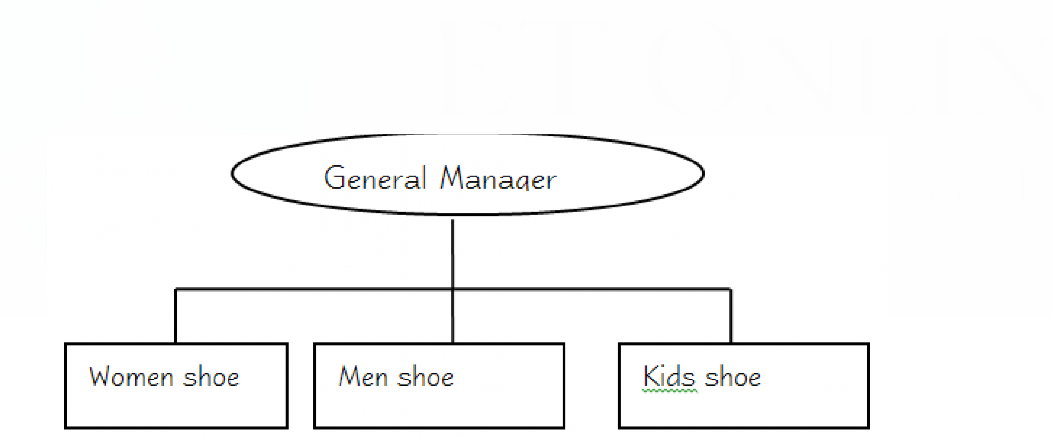
—) Customers are the key to the way activities are grouped.
—) Such forms of departmentalization are more common in banking, book publishing and food industry.

– Departmentalization by Process:
—) It is appropriate when departmentalization by production is inflow.

process.
—) Under it activities are grouped on the basis of various manufacturing

– Delegation is authorizing subordinates to act in a certain manner independently.

– Delegation helps to facilitate work being accomplished.
– It is a concept describing the passing of formal authority to another

– It is delivering to another the right to act; to make decision; to
requisition resources; and to perform other tasks in order to fulfill jobs responsibility.

– Delegation is a two side relationship, i.e. the assigner and assignee.
– It is an act of trust; an expression of confidence; requires necessary skills and strength, and requisite application and dedication to duties.

– Delegation occurs for two purposes:
—) When managers are absent from their jobs

—) To develop subordinates and facilitate decision making process.
- Subordinates act on behalf and exercise authority.

– Delegation is essential to obtain prompt action.
– Delegation enables managers to perform higher level work.
– Delegation can be a training experience for supportive staff.

– Delegation can result in better decisions.
– Delegation can improve morale.

– Control at the top may be more difficult.

– A manager may over time lose touch with what is really happening in the organization.

– Common factors determining the delegation of authority are:
—) Importance of the decision

—) Management style and philosophy
—) Availability of capable Managers
—) Size of the organization

– Authority:
—) The rights inherent in a managerial position to give orders and to expect the orders to be obeyed.

– Chain of Command:
—) The unbroken line of authority that extends from the top of the organization to the lowest echelon and clarifies who reports to whom.
– Unity of Command:
—) A subordinate should have only one superior to whom he or she is directly responsible.

– A concern of all managers in applying staff and functional authority is

violation of the principle of unity of command, one of Henri Fayol’s management principles.
—) The principle requires that each person within the organization take orders from and report to only one person.
—) Unity of command should guide any attempt to develop operating relationships.

– Although each person should have only one boss, the operating

relationships developed through staff departments mean that workers may have more than one supervisor in a given situation - or at least perceive that they do from the style with which advice is given.
– A departmental manager or subordinate may receive guidance or
directives on a given day from human resources on employment practices, from finance on budget time frames, and from data processing concerning computer procedures.

– If possible, these situations should be minimized, or at least clarified, for the sake of all affected.

– It is a sound general principle for all kinds of organizations that any
member of the organization should have only one ―master.‖
– There is wisdom in the old proverb of the Roman law that a slave who has three masters is a free man.
– It is a very old principle of human relations that no one should be put
into a conflict of loyalties - and having more than one master creates such a conflict.

– Span of Control:

– The number of subordinates a manager can efficiently and effectively direct.
– Concept:
—) Wider spans of management increase organizational efficiency.
– Narrow Span Drawbacks:
—) Expense of additional layers of management.
—) Increased complexity of vertical communication.
—) Encouragement of overly tight supervision and discouragement of employee autonomy.

– Centralization:
—) The degree to which decision making is concentrated at a single point in the organization.

– Decentralization:
—) The degree to which decision making is spread throughout the organization.
– Formalization:
—) The degree to which jobs within the organization are standardized.

– Simple Structure:

formalization.
– A structure characterized by a low degree of departmentalization, wide spans of control, authority centralized in a single person, and little

– Bureaucracy:

– A structure of highly operating routine tasks achieved through specialization, very formalized rules and regulations, tasks that are grouped into functional departments, centralized authority, narrow
spans of control, and decision making that follows the chain of command.

– Strengths:
—) Functional economies of scale

—) Enhanced communication
—) Centralized decision making
—) Minimum duplication of personnel and equipment

– Weaknesses:
—) Subunit conflicts with organizational goals.

—) Lack of employee discretion to deal with problems.
—) Obsessive concern with rules and regulations.

– Matrix Structure:

– A structure that creates dual lines of authority and combines functional and product departmentalization.
– Key Elements:
—) Gains the advantages of functional and product departmentalization while avoiding their weaknesses.
—) Facilitates coordination of complex and interdependent activities.
—) Breaks down unity-of-command concept.


(Director)
(Dean)
Employee

– Team Structure:
– The use of teams as the central device to coordinate work activities.

– Characteristics:
—) Breaks down departmental barriers.
—) Decentralizes decision making to the team level.
—) Requires employees to be generalists as well as specialists.
—) Creates a ―flexible bureaucracy‖.

– Virtual Organization:
– A small, core organization that outsources its major business functions.
– Highly centralized with little or no departmentalization.

– Concepts:
—) Advantage: Provides maximum flexibility while concentrating on what the organization does best.
—) Disadvantage: Reduced control over key parts of the business.

– Boundaryless Organization:

– An organization that seeks to eliminate the chain of command, have limitless spans of control, and replace departments with empowered teams.
– T-form Concepts:
—) Eliminate vertical (hierarchical) and horizontal (departmental) internal boundaries.
—) Breakdown external barriers to customers and suppliers.

– Mechanistic Model:

– A structure characterized by extensive departmentalization, high formalization, a limited information network, and centralization.

– Organic Model:

– A structure that is flat, uses cross-hierarchical and cross-functional teams, has low formalization, possesses a comprehensive information network, and relies on participative decision making.

– Innovation Strategy:
—) A strategy that emphasizes the introduction of major new products and services.

– Cost-minimization Strategy:
—) A strategy that emphasizes tight cost controls, avoidance of unnecessary innovation or marketing expenses, and price cutting.
– Imitation Strategy:
—) A strategy that seeks to move into new products or new markets only after their viability has already been proven.

– Size:

organization grows larger, it becomes more mechanistic.
– Characteristics of large organizations:
—) More specialization
—) More vertical levels
—) More rules and regulations
—) How the size of an organization affects its structure. As an

– Technology:
– How an organization transfers its inputs into outputs.

– Characteristics of routineness (standardized or customized) in activities:
—) Routine technologies are associated with tall, departmentalized structures and formalization in organizations.
—) Routine technologies lead to centralization when formalization is low.
—) Non-routine technologies are associated with delegated decision authority.

– Environment:

– Institutions or forces outside the organization that potentially affect the organization’s performance.
– Key Dimensions:
—) Capacity: The degree to which an environment can support growth.
—) Volatility: The degree of instability in the environment.
—) Complexity: The degree of heterogeneity and concentration among environmental elements.

– Power:
—) A capacity that A has to influence the behavior of B so that B acts in accordance with A’s wishes.

– Dependency:
—) B’s relationship to A when A possesses something that B requires.
– A person or group cannot have power in isolation; power has to be exercised or have the potential for being exercised in relation to some other person or group.

– Power may exist but not be used. It is, therefore, a capacity or potential.

– Probably the most important aspect of power is that it is a function of
dependency.
– The greater B’s dependence on A, the greater is A’s power in the relationship.
– Dependence, in turn, is based on alternatives that B perceives and the
importance that B places on the alternative(s) that A controls.
– A person can have power over you only if he or she controls something you desire.

– Formal Power:

—) Is established by an individual’s position in an organization; conveys the ability to coerce or reward, from formal authority, or from control of information.
– Coercive Power:
—) A power base dependent on fear.
– Reward Power:
—) Compliance achieved based on the ability to distribute rewards that others view as valuable.

– Legitimate Power:

—) The power a person receives as a result of his or her position in the formal hierarchy of an organization.

– Expert Power:
—) Influence based on special skills or knowledge.

– Referent Power:
—) Influence based on possession by an individual of desirable resources or personal traits.

– Steps for Managers to Take to Prevent Sexual Harassment:
—) Make sure a policy against it is in place.

—) Ensure that employees will not encounter retaliation if they file a complaint.
—) Investigate every complaint and include the human resource and legal departments.
—) Make sure offenders are disciplined or terminated.
—) Set up in-house seminars and training.

– Political Behavior:

—) Activities that are not required as part of one’s formal role in the organization, but that influence, or attempt to influence, the distribution of advantages or disadvantages within the organization.
– Legitimate Political Behavior:
—) Normal everyday politics.
– Illegitimate Political Behavior:
—) Extreme political behavior that violates the implied rules of the game.

– Maintain open communication.
– Clarify performance expectations.
– Use participative management.

– Encourage cooperation among work groups.
– Manage scarce resources well.
– Provide a supportive organizational climate.

– Deciding to use a team in group decision making when:
—) Many perspectives are needed.

—) Acceptance of the decision is critical.
—) The problem is complex or unstructured.
—) Individual’s judgments are unreliable.
—) Individuals are unwilling to take necessary risks.
—) You want to develop team members’ team-related skills.

– Organizational structure has significance of ensuring the management of the organization to:

—) Encourage growth
—) Use of technology
—) Optimize utilization of human resources
—) Stimulate creativity
—) Facilitate administration

– Power: A capacity that A has to influence the behavior of B so that B acts in accordance with A’s wishes.

– Political Behavior: Activities that are not required as part of one’s
formal role in the organization, but that influence, or attempt to influence, the distribution of advantages or disadvantages within the organization.


– By the end of this chapter, you will be able to:
—) Explain organizational culture.

—) Discuss organization development.
—) Discuss the way employees learn culture.

– What is culture?
– Is there organizational Culture?
– Example?


– Organizational culture has been described as the shared values,
principles, traditions, and ways of doing things that influence the way organizational members act.

– Culture is not something that can be physically touched or seen, but employees perceive it on the basis of what they experience within the
organization.

– Culture is descriptive.

– It’s concerned with how members perceive the culture and describe it, not with whether they like it.
– Even though individuals may have different backgrounds or work at
different organizational levels, they tend to describe the organization’s culture in similar terms. That’s the shared aspect of culture.

– Two basic components are:

—) The forms, functions, events, and practices of an organization.
—) The meanings contained in its ideologies, values, and norms of an organization.

– Culture is a liability when:

—) Shared values do not agree with those that will improve the organization’s effectiveness.
—) Consistency of behavior is an asset when the environment is stable but may be a liability when environment is undergoing change and members resist changing the culture.

– The shared values, principles, traditions, and ways of doing things that
influence the way organizational members act.

—) First, culture is a perception:
It’s not something that can be physically touched or seen, but employees perceive it on the basis of what they experience within the organization.

– The shared values, principles, traditions, and ways of doing things that influence the way organizational members act.

—) Second, organizational culture is descriptive:
It’s concerned with how members perceive the culture and describe it, not with whether they like it.
—) Finally, even though individuals may have different backgrounds or work at different organizational levels, they tend to describe the
organization’s culture in similar terms.
That’s the shared aspect of culture.

– Organizational culture is concerned with how employees perceive the
characteristics of an organization’s culture, not with whether or not they like them.

– Individuals with different backgrounds or at different levels in the
organization will tend to describe the organization’s culture in similar terms.
– Organizational culture has common properties does not mean, however, that there cannot be subcultures within any given culture.
– Most large organizations have a dominant culture and numerous sets of
subcultures.

– Dominant Culture:
—) Expresses the core values that are shared by a majority of the organization’s members.

– Subcultures:
—) Mini- cultures within an organization, typically defined by department designations and geographical separation.
– Core Values:
—) The primary or dominant values that are accepted throughout the organization.

– Culture is a Liability When:

—) A environment is undergoing change and members resist changing the culture.
—) Shared values do not agree with those that will improve the organization’s effectiveness.

– An organization’s culture can often be described in terms of how employees perceive the following characteristics:

—) Innovation and Risk-taking: The degree to which employees are encouraged to be innovative and take risks.
—) Attention to Detail: The degree to which employees are expected to exhibit precision, analysis, and attention to detail.
—) Outcome Orientation: The degree to which management focuses on results rather than on processes.

—) People Orientation: The degree to which management decisions take into consideration the effect of outcomes on people within the organization.
—) Team Orientation: The degree to which work activities are organized around teams rather than individuals.
—) Aggressiveness: The degree to which people are aggressive and competitive rather than easygoing.
—) Stability: The degree to which organizational activities emphasize maintaining the status quo in contrast to growth.

—) Member Identity: The degree to which individuals identify with the organization as a whole rather than some subgroup or specialization.
—) Unit Integration: The amount of encouragement of coordinated, interdependent activity among unites.
—) Control: the degree to which rules and supervision is used to control employees.

—) Reward Criteria: The extent to which rewards are based on performance rather than seniority or favoritism
—) Conflict Tolerance: the degree to which open airing of conflict is encouraged
—) Means-end Orientation: The extent of managerial focus on outcomes and results rather than processes
—) Open-systems Focus: The amount of monitoring of external developments.

– Creates a distinction between one organization and others.
– Conveys a sense of identity for organizational members.
– Generates a commitment to something larger than one’s self-interest.

– Enhances the stability of the organization’s social system (e.g., provides standards for what employees should say and do).
– Helps shape the attitudes and behavior of employees.

– The integration of organizational goals and personal goals.

– The most appropriate organization structure based on the demands of the socio technical system.
– Democratic functioning of the organization with full opportunities for
participation.
– Justice in treatment with equitable HRM and employment relations policies and practices.

– Mutual trust, consideration and support among different levels of the organization.
– The open discussion of conflict with an attempt to avoid confrontation.

– Managerial behavior and styles of leadership appropriate to the particular work situations.
– Acceptance of the psychological contract between the individual and the
organization.
– Recognition of people’s needs and expectations at work and individual differences and attributes.

– Equitable systems of rewards based on positive recognition.
– Concern for the quality of working life and job design.
– Opportunities for personal development and career progression.

– A sense of identity with, and loyalty to, the organization and a feeling of being a valued and important member.

– Employees often learn culture from:

—) The ways that the members of a group or organization typically communicate or express themselves such as:
—) The substance of public functions or events staged by a group such as rites, ceremonials, and rituals.
Stories | Myths | Sagas |
Legends | Folktales | Symbols |
Language |

– Rite: A ceremony or event – for example, marriage, marking an important stage in someone’s life.

—) Is a relatively elaborate, dramatic, and planned set of activities that consolidates various forms of cultural expressions into a single event, which is usually carried out through social interaction for the benefit of an audience.
Wedding ceremony
Awarding the salesperson of the year at the annual company banquet

– Stories: Are accounts of true events, but they often contain both truth and fiction.

– Organizational members often tell stories repeatedly about:
—) Organization’s founders
—) Consequences of rule breaking
—) Rags-to-riches successes
—) Reductions in the workforce
—) Relocation of employees
—) Reactions to past mistakes
—) Organizational coping

– Myths: A traditional story concerning the early history of a people or

explaining a natural or social phenomenon, and typically involving supernatural beings or events.
—) A widely held but false belief. /a fictitious person or thing./ an exaggerated or idealized conception of a person or thing.
—) Can be a type of story (dramatic narrative of imagined events used to explain the origins or transformations of something) or a type of belief (an unquestioned belief about the practical benefits of certain techniques or behaviors that is not supported by facts).
—) Differ from stories in that they lack a factual basis.

– Sagas: Are another category of stories that consist of historical

—) A long story of heroic achievement.
narratives describing the unique accomplishments of a group or its leaders.

– Legends

—) Are stories about some event that has actually occurred, but has been embellished with fictional details.
—) A traditional story popularly regarded as historical but which is not authenticated.
—) An extremely famous or notorious person.
– Folktales
—) Are purely fictional stories.
—) A traditional story originally transmitted orally.

– Language: May be used as a way to identify members of a culture or

subculture through the development of specialized jargon or gestures, which often are not recognizable to outsiders.
—) Nick name of office campus.
—) Nickname of division or person’s position.
—) Unique names to describe equipment, offices, key personnel, suppliers, customers, or products related to the organization’s functions.

– Language:

that relate to its business.
– Organizations, over time, often develop unique terms to describe equipment, offices, key personnel, suppliers, customers, or products

– Symbols: Are any object, act, event, quality, or relation that serves for conveying meaning.

—) They can also express the degree of egalitarianism desired by top management as well as desirable behaviors.
—) Example: Degree of risk taking, frugality, authoritarianism, participative, individualistic, social, conservative and so on.

– Ceremonials:
—) Are a system of several rites connected to a single occasion/event.

—) A company banquet where several awards are made to recognize performance
—) The OSCARS
—) A university’s graduation ceremony.

– Rituals:

people are important and which are expendable.
—) Repetitive sequences of activities that express and reinforce the key values of the organization, what goals are most important, which

– An organization’s culture, especially a strong one, influences and constrains the way managers’ plan, organize, lead and control.

– Planning:
—) The degree of risk that plans should contain.
—) Whether plans should be developed by individuals or teams.
—) The degree of environmental scanning in which management will engage.

– Organizing:
—) How much autonomy should be designed into employees’ jobs?

—) Whether tasks should be done by individuals or in teams?
—) The degree to which department managers interact with each other?

– Leading:

—) What leadership styles are appropriate?
—) Whether all disagreements, even constructive ones, should be eliminated.
—) The degree to which managers are concerned with increasing employee job satisfaction.

– Controlling:

—) Whether to impose external controls or to allow employees to control their own actions?
—) What criteria should be emphasized in employee performance evaluations?
—) What repercussions will occur from exceeding one’s budget?

– Changing an organization’s culture is difficult because it is made up of

—) Written statements about an organization’s mission or philosophy
—) Design of physical spaces and buildings
—) Dominant leadership style
—) Historical selection criteria

– Changing an organization’s culture is difficult because it is made up of

—) Past promotion practices
—) Entrenched rituals
—) Popular stories about key people or events
—) Past performance evaluation criteria
—) Formal structure of the organization

– Cultural change is more likely to occur when the following conditions exist:

—) Turnover in leadership
—) Young and small organizations
—) The culture that currently exists is relatively weak
—) A dramatic crisis exists or is created

– To encourage the development of a more ethical culture management
should:

—) Be a visible role model
—) Communicate ethical expectations
—) Provide ethical training
—) Visibly reward ethical acts and punish unethical ones
—) Provide protective mechanisms so employees can discuss ethical dilemmas.

– Change: Making things different.
– Planned Change: Activities that are intentional and goal oriented.

– Change Agents: Persons who act as catalysts and assume the responsibility for managing change activities.
– Goals of Planned Change:
—) Improving the ability of the organization to adapt to changes in its environment.
—) Changing the behavior of individuals and groups in the organization.

– Forms of Resistance to Change:
—) Overt and Immediate

Voicing complaints, engaging in job actions.
—) Implicit and Deferred
Loss of employee loyalty and motivation, increased errors or mistakes, increased absenteeism.

etonline.edu.et


– Tactics for dealing with resistance to change include:
—) Education and communication

—) Participation
—) Facilitation and support
—) Negotiation
—) Manipulation and cooptation
—) Selecting people who accept change
—) Coercion
Forces that direct behavior away from the status quo.
Forces that hinder movement from the existing equilibrium.

•
Change efforts to overcome the pressures of both individual resistance and group conformity.
•
Stabilizing a change intervention by balancing driving and restraining forces.


– Establish a sense of urgency by creating a compelling reason for why change is needed.
– Form a coalition with enough power to lead the change.

– Create a new vision to direct the change and strategies for achieving the vision.
– Communicate the vision throughout the organization.

– Empower others to act on the vision by removing barriers to change and encouraging risk taking and creative problem solving.

– Plan for, create, and reward short-term ―wins‖ that move the
organization toward the new vision.
– Consolidate improvements, reassess changes, and make necessary adjustments in the new programs.
– Reinforce the changes by demonstrating the relationship between new
behaviors and organizational success.

– Organizational Development: A collection of planned interventions,
built on humanistic-democratic values, that seeks to improve organizational effectiveness and employee well-being.

– Organizational Development Values:
—) Respect for people
—) Trust and support
—) Power equalization
—) Confrontation
—) Participation

– Sensitivity Training.

– Training groups (T-groups) that seek to change behavior through unstructured group interaction.
– Provides increased awareness of others and self.
– Increases empathy with others, improves listening skills, greater openness, and increased tolerance for others.

– Survey Feedback Approach.

– The use of questionnaires to identify discrepancies among member perceptions; discussion follows and remedies are suggested.

– Process Consultation.

– A consultant gives a client insights into what is going on around the client, within the client, and between the client and other people; identifies processes that need improvement.

– Team Building.
– High interaction among team members to increase trust and openness.

– Team Building Activities:
—) Goal and priority setting.
—) Developing interpersonal relations.
—) Role analysis to each member’s role and responsibilities.
—) Team process analysis.

– Appreciative Inquiry.

– Seeks to identify the unique qualities and special strengths of an organization, which can then be built on to improve performance.
– Appreciative Inquiry:
—) Discovery: Recalling the strengths of the organization.
—) Dreaming: Speculation on the future of the organization.
—) Design: Finding a common vision.
—) Destiny: Deciding how to fulfill the dream.

– Innovation: A new idea applied to initiating or improving a product, process, or service.
– Sources of Innovation:
—) Structural Variables
Organic structures
Long-tenured management Slack resources
Interunit communication
—) Organization’s Culture
—) Human Resources

– Idea Champions: Individuals who take an innovation and actively and enthusiastically promote the idea, build support, overcome resistance, and ensure that the idea is implemented.

– Learning Organization: An organization that has developed the continuous capacity to adapt and change.

– Characteristics:
—) Holds a shared vision
—) Discards old ways of thinking
—) Views organization as system of relationships
—) Communicates openly
—) Works together to achieve shared vision

– Single-Loop Learning
—) Errors are corrected using past routines and present policies.

– Double-Loop Learning
—) Errors are corrected by modifying the organization’s objectives, policies, and standard routines.

– Fundamental Problems in Traditional Organizations:
—) Fragmentation based on specialization.

—) Reactiveness that misdirects attention to problem-solving rather than creation.
—) Overemphasis on competition.


– Organizational culture has been described as the shared values,
principles, traditions, and ways of doing things that influence the way organizational members act.

– Employees often learn culture from the substance of public functions or events staged by a group such as rites, ceremonials, and rituals.

– Cultural change is more likely to occur when the following conditions exist:

—) Turnover in leadership
—) Young and small organizations
—) The culture that currently exists is relatively weak
—) A dramatic crisis exists or is created

– Organizational Development: Is a collection of planned interventions,

built on humanistic-democratic values, that seeks to improve organizational effectiveness and employee well-being.

